Heart-Healthy Eating on the Go for Busy People
Disclosure: Some of the links below are affiliate links. This means if you click through and take action, I may receive a small commission (at no extra cost to you). This helps support the free content on this blog while I only recommend tools and foods I truly believe in for your heart health journey.
Marcus is a long-haul trucker. Two months ago, he had a stent placed in his left anterior descending artery. His cardiologist told him to follow a low-sodium, heart-healthy diet. The hospital dietitian gave him a meal plan, a grocery list, and a printout of the DASH diet guidelines.
None of it accounted for the fact that Marcus spends 11 hours a day in a cab, eats most of his meals from gas stations and truck stops, and has no refrigerator, no stove, and no cutting board.
When I spoke with Marcus, he was frustrated. "I know what I'm supposed to eat," he told me. "I just can't find it anywhere I actually am."
Marcus didn't have a knowledge problem. He had an opportunity problem. And that distinction changes everything about how we approach heart-healthy eating on the go.
This guide is for people like Marcus. It's also for the nurse finishing a 12-hour overnight shift. It's for the consultant who eats three meals a week in airports. It's for anyone whose busy life doesn't fit neatly into a meal-prep-Sunday Instagram grid, but whose heart still needs protection.
This is your survival guide.
The Short Version: Healthy eating on the go isn't about willpower. It's about engineering your environment so the right choice is the easiest one. This post gives you a 3-Part Assembly Meal framework, pre-committed "scripts" for high-risk moments, and a friction-reduction toolkit — all grounded in behavior science and clinical nutrition research.
1. Why "Trying Harder" Doesn't Work When You're Exhausted
Most cardiac nutrition advice assumes you have a kitchen, a full refrigerator, and 30 minutes to cook. For shift workers, travelers, and professionals constantly on the move, that assumption is a fantasy.
Research on shift workers and frequent travelers consistently shows that these populations face disrupted meal patterns, higher intake of processed and convenience foods, and greater exposure to high-sodium, high-sugar environments. [1] This isn't laziness. It's the natural consequence of a food environment that's been engineered against you.
The behavior science framework known as COM-B — developed to understand why people do or don't do things — breaks behavior into three requirements: Capability (do you know how?), Opportunity (do you have access?), and Motivation (do you want to?). [2]
For most cardiac patients on the go, motivation is not the problem. You survived a cardiac event. You are motivated. The bottleneck is almost always Opportunity — the physical access to healthy food at the moment you're hungry.
That's good news. Because opportunity is something we can engineer.
2. The Grocery-First Rule: One Habit That Changes Everything
Here is the single highest-leverage habit for anyone who eats on the go: visit a grocery store once every 24 hours before defaulting to convenience outlets.
This sounds so simple, and it is. That's the point. Let me explain.
A grocery store — even a small one — gives you access to fresh fruit, yogurt, pre-made salads, rotisserie chicken, hummus cups, nuts, canned fish, and sparkling water. A gas station gives you instant noodles, chips, candy bars, and 44-ounce sodas.
The Grocery-First Rule is what behavior scientists call an Opportunity Intervention.
It changes what's available to you later, when you're tired and your decision-making capacity is depleted. You're not relying on willpower at 11 PM in a truck stop or the cup noodles in your pantry. You're relying on the fact that you already have a protein pouch and an apple in your bag because you stopped at a Kroger that morning.
I recently worked with a traveling consultant named Angela. She was eating airport food four times a week and her sodium intake was consistently above 3,000 mg — double the AHA recommendation for cardiac patients. We didn't change her knowledge. We changed her morning routine.
Before every travel day, her first stop after checking into the hotel was the nearest grocery store for a 5-minute restock: Greek yogurt, bananas, almonds, sparkling water, and a pre-made salad for dinner. If you don't have time to shop at the nearest grocery store, I have a list of ready-to-eat shelf-stable options at the end of this post to pack with you on the go in section 6.
Within three weeks, Angela's average daily sodium dropped to 1,800 mg. Her blood pressure went from 142/88 to 128/78. She changed one habit — and it cascaded.
3. The 3-Part Assembly Meal: Your Portable Heart Healthy Plate
You don't need a kitchen to eat well. You need a template.
The Assembly Meal framework builds every eating occasion from three components:
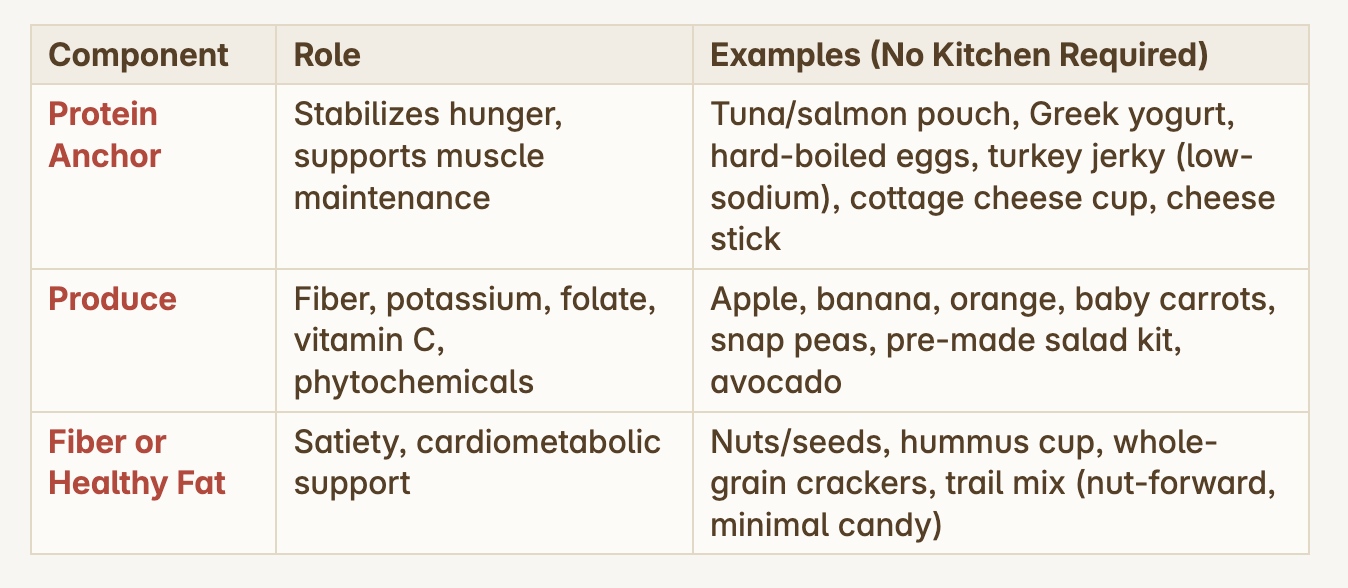
The Assembly Meal Framework
This is the portable version of the Cardiac Plate method I teach in my book, The Cardiac Comeback. Same clinical logic — half produce, quarter protein, quarter whole grain — adapted for zero-kitchen environments.
What to do on the go for each scenario
Airport: Look for the protein box or salad bowl near grab-and-go. Pair with a whole fruit and water. Skip anything described as "crispy," "loaded," or "smothered."
Gas Station or Truck Stop: Protein first, produce second. Grab a cheese stick or jerky pouch (low sodium if possible), then find the banana or apple display (most larger stations have one near the register). Add a bottle of water. Total cost: under $6.
Hotel Lobby Pantry: Look for nuts, yogurt cups, or string cheese in the mini fridge section. Pair with any fresh fruit available.
Convenience Store (7-Eleven, Wawa, etc.): Many now carry hard-boiled egg packs, hummus-and-pretzel cups, and fresh fruit. Choose those over the hot dog roller.
4. The "If-Then" Scripts: Pre-Committed Decisions That Protect Your Heart
Research on implementation intentions — "If X happens, then I will do Y" statements — shows they have a medium-to-large effect on goal attainment across dozens of studies. [3] The reason is simple: they remove the need for decision-making at the moment of temptation. You've already decided.
Here are three scripts designed for the three highest-risk environments cardiac patients face:
The Airport Script
"If I am in an airport terminal, then I will order a salad bowl or protein box with water and one whole fruit."
The Convenience Store Script
"If I enter a convenience store, then I will buy a protein item and a produce item before considering anything else."
The Late-Night Shift Script
"If I am hungry after midnight on shift, then I will eat a protein-forward snack and drink water. If I am still hungry after 15 minutes, I will add produce."
Write these down. Put them in your phone notes. Read them before you walk into the environment. The goal is to automate the decision so your tired brain doesn't have to negotiate with a wall of candy at 2 AM.
5. What Happens When You Don't: The Clinical Cost of "Just This Once"
I want to be direct about this, because I believe you deserve the truth.
A single restaurant or fast-food meal can contain 2,000 to 3,000 mg of sodium — your entire daily budget in one sitting. [4] For a cardiac patient, that sodium spike causes acute water retention, raises blood pressure, and stresses the endothelium — the delicate lining of your blood vessels.
Now, let's talk about meal timing — because I hear this question a lot: "I skip breakfast and eat late, but I do it every day. Is that a problem?"
Here's what the research suggests: consistency itself has protective value. If you eat on a regular schedule — even a late one — your body can adapt its metabolic rhythms accordingly. The real damage comes from irregular patterns: eating at 7 AM on Monday, midnight on Tuesday, skipping meals on Wednesday. That kind of unpredictability disrupts insulin signaling, cortisol rhythms, and blood pressure regulation.
A study on firefighters working 24-hour shifts tested this idea directly. Researchers asked participants to simply keep their eating within a consistent 10-hour window — a form of Time-Restricted Eating. After 12 weeks, those with higher baseline cardiometabolic risk showed improvements in VLDL particle size, HbA1c, and diastolic blood pressure. [5] The takeaway: when you eat matters, not just what you eat.
But what if your schedule rotates — some day shifts, some nights? This is the hardest scenario, and honesty matters here. You can't fully control your circadian clock when your shifts keep changing. What you can control is anchoring your first meal to within 1–2 hours of waking, regardless of what time that is. If you wake at 5 AM for a day shift, your first protein + produce meal happens by 7 AM. If you wake at 5 PM for a night shift, that same meal happens by 7 PM. The anchor moves with your wake time — the structure stays the same.
This isn't about perfection. It's about preventing an unhealthy pattern of "just this once" from becoming "every shift."
6. Reduce the Friction: Tools That Make It Effortless to Be Heart Healthy
One of the most underrated barriers to healthy eating on the go is the cleanup problem. You might be willing to blend a protein smoothie — but not willing to scrub a blender in a hotel bathroom sink at 6 AM.
If the thought of washing dishes after a 12-hour shift is what's stopping you from fueling well, look for tools designed to eliminate that friction:
The Two-Tier Travel Kit
Tier 1: Shelf-Stable Emergency Kit (Always in Your Bag)
Keep these packed at all times. They require no refrigeration, no prep, and no cleanup.
Roasted chickpea or lentil snacks
Nut packets (almonds, walnuts — pre-portioned to 1 oz to avoid overeating)
Whole fruit (apples, oranges, bananas)
Whole-grain crackers or crispbread
Ready-to-eat lentil or barley cups — shelf-stable, high-fiber, and ready in 90 seconds
Shelf-stable dal pouches — organic, fully cooked lentil meals you can microwave right in the pouch
Shelf-stable protein milk or UHT milk (ultra-high temperature pasteurized — this is regular milk processed at a high temperature so it stays safe at room temperature for months without refrigeration; check the label for added sugar)
Tier 2: Cooler-Based Upgrade (When You Have Access)
For road trips or multi-day travel with a small cooler or hotel mini-fridge:
Hard-boiled eggs (store-bought packs)
Greek yogurt or cottage cheese cups (choose the ones with lower sodium or limit the portion size)
Hummus cups with baby carrots or snap peas
Pre-made salad plus a protein pouch (tuna, chicken)
Cheese sticks paired with fruit
Tip: Use an insulated lunch tote with a reusable ice pack. Cold perishables must stay at 40 degrees Fahrenheit or below and should not sit in the "danger zone" for more than 2 hours (1 hour if it's above 90 degrees Fahrenheit outside). [6]
Portable Prep Tools
If you want to go beyond assembly meals, a portable blender with a detachable travel cup can turn a protein shake from a 10-minute chore into a 2-minute routine. The Ninja Blast Portable Blender is a solid option — it's cordless, USB-C rechargeable, has a leakproof sip spout, and the 18 oz vessel doubles as your drinking cup. Blend, cap it, and walk out the door. Dishwasher-safe parts mean cleanup is minimal. This is particularly useful for shift workers who need a protein-dense breakfast but have zero patience for prep at 5 AM.
If a portable blender isn't for you, single-serve Greek yogurt cups and pre-packaged cottage cheese achieve the same protein goal with zero equipment. The best tool is the one you'll actually use.
7. The Weekly Rhythm: Anchors and Flex Zones
Consistency doesn't mean rigidity. It means having two anchor points that hold your day together, no matter how chaotic the rest gets.
Anchor 1: The Morning Protein Rule
Your first eating occasion of the day includes a protein source and one produce item. Even if appetite is low: a yogurt and a banana counts. This stabilizes blood sugar, reduces midday volatility, and sets the metabolic tone for the day.
Anchor 2: The Midday Smart Choice
At some point during your day — a lunch break at the hospital, a fuel stop on a long haul, a layover between flights — you will face a food decision. This is your anchor moment. Instead of reaching for whatever is fastest, apply the Assembly Template: grab one protein item and one produce item. Think of it as a 60-second quality check, not a grocery run. If you already packed your Tier 1 Kit, this is just opening your bag instead of walking to the vending machine.
Flex Zone: Dinner
Dinner is the wildcard. Some nights you'll have time to assemble a proper meal. Some nights you won't. On the worst nights, use the "Acceptable Minimum": protein + water + one produce item. That's it. That still protects your heart more than skipping dinner and rebounding to vending machines at midnight.
8. Tracking Without Obsessing: Two Metrics, 30 Seconds
Self-monitoring is one of the most consistently effective behavior-change techniques in dietary interventions. [7] But for people on the go, tracking must be nearly invisible.
Track only two things daily:
Did I hit my protein anchor at my first meal? (Yes / No)
How many produce servings did I eat today? (0, 1, 2+)
That's it. Use a notes app or a checkbox. It takes 30 seconds.
Review weekly: Look at the pattern. If you missed your protein anchor three or more days, ask yourself: was it a Capability problem (didn't know what to grab?), an Opportunity problem (nothing available?), or a Motivation problem (too stressed to care?). Then change that one lever.
This is the exact diagnostic loop from the COM-B framework. Simple, clinical, and effective.
9. Your Action Plan: Start This Week
Don't try to overhaul everything. Build the system in layers:
This week:
Choose your two default meals (default breakfast, default snack) from the Assembly Meal table above.
Pack one shelf-stable emergency meal in your work bag or car.
Write your three "If-Then" scripts and save them in your phone.
Next week:
Implement the Grocery-First Rule on at least 3 days.
Start tracking your two daily metrics (protein anchor + produce count).
Within 30 days:
You should have 5 to 7 "go-to" items that you buy on autopilot.
Your protein anchor should be hitting on at least 70% of days.
You'll notice something: you've stopped thinking about it. That's automaticity. That's the goal.
The Bottom Line
Marcus didn't need another meal plan. He needed a system that worked inside the cab of a truck at 11 PM. Angela didn't need more nutrition education. She needed a 5-minute restock habit that cascaded into lower blood pressure.
If your life is messy, mobile, and unpredictable, your cardiac nutrition strategy has to be built to adapt to that reality. Not perfect. Not rigid. Just engineered for the real world.
For a deeper dive into building the foundation of your cardiac nutrition — from understanding cholesterol to rebuilding your kitchen — check out the full recovery roadmap in The Cardiac Comeback. And if you want my complete 7-Day Reset plan with daily meal guides, download the free tracker using the form below.
Keep going.
Citations and Scientific Resources
[1] Energy intake of shift workers compared to fixed day workers: A systematic review and meta-analysis — Bonham, M.P. et al. (2016). Chronobiology International, 33(8), 1086-1100.
[2] The COM-B Model and Behavior Change Wheel — Michie, S., van Stralen, M.M., & West, R. (2011). Implementation Science, 6, 42.
[3] Implementation Intentions and Goal Attainment: A Meta-Analysis — Gollwitzer, P.M. & Sheeran, P. (2006). Advances in Experimental Social Psychology, 38.
[4] American Heart Association: Sodium and Your Health
[5] Ten-Hour Time-Restricted Eating Reduces Weight, Blood Pressure, and Atherogenic Lipids in Patients with Metabolic Syndrome ("Healthy Heroes" Trial) — Manoogian, E.N.C. et al. (2022). Cell Metabolism, 34(10), 1572-1585.
[6] USDA Food Safety: Safe Minimum Internal Temperatures
[7] Self-Monitoring in Weight Loss: A Systematic Review of the Literature — Burke, L.E., Wang, J., & Sevick, M.A. (2011). Journal of the American Dietetic Association, 111(1), 92-102.